Tag: cholesterol

  • 🥓 The Ketogenic Diet, LDL Cholesterol, and Heart Health – What the Latest Study Shows

    The ketogenic (keto) diet has gained huge popularity in recent years. Some follow it for weight loss, others for blood sugar control or overall metabolic health. Yet one key question remains:

    👉 Does the rise in LDL cholesterol (often called “bad cholesterol”) seen on keto automatically mean a higher risk of heart disease?

    A groundbreaking study led by Dave Feldman and Dr. Matthew Budoff (Cedars-Sinai, USA), published in 2024/2025, brings surprising answers.


    🔬 Who Are Lean Mass Hyper-Responders (LMHR)?

    These are people who, on a ketogenic diet, experience:

    • very high LDL cholesterol (often >200 mg/dL),
    • high HDL (“good cholesterol”),
    • low triglycerides,
    • lean body mass and excellent metabolic health.

    This unique profile is called Lean Mass Hyper-Responder (LMHR). For doctors and patients alike, it raises questions, since traditional medicine links high LDL directly with heart disease.


    🧪 How Was the KETO-CTA Study Done?

    • 80 participants on keto for an average of 4.7 years, all with LDL ≥190 mg/dL (average ~272 mg/dL, some up to 591 mg/dL).
    • 80 matched controls from the MiHeart study with typical LDL (~123 mg/dL).
    • Both groups were similar in age, sex, BMI, blood pressure, and smoking history.
    • Researchers used advanced imaging: coronary CT angiography (CCTA) and CAC scoring, which measure arterial plaque and calcium buildup in the heart.

    📊 Key Results

    • No difference in total plaque volume between the keto group and controls.
    • CAC score (arterial calcium) – median = 0 in the keto group vs 1 in controls.
    • No correlation between LDL levels and plaque burden, even when LDL exceeded 500 mg/dL.

    👉 In other words: for LMHR individuals, high LDL did not translate into more arterial plaque in this study.


    💡 What Does This Mean?

    • Individual response matters – not everyone on keto reacts the same way.
    • LDL is not the whole story – markers like ApoB, HDL, triglycerides, and insulin sensitivity may give a better picture of risk.
    • Monitoring is key – imaging tests (CAC, CCTA) can show real cardiovascular health rather than relying only on LDL numbers.
    • Short-term data – participants were on keto ~5 years. Heart disease often takes decades, so more long-term research is needed.

    🦶 Why Write About This on a Foot Health Blog?

    Because heart and vascular health directly affect foot health.

    • Poor circulation can cause serious foot complications.
    • Strong metabolic health protects not only the heart, but also the feet that carry us every day.

    ✅ Bottom Line

    The Feldman-Budoff study suggests that for Lean Mass Hyper-Responders, very high LDL on keto may not automatically mean higher heart disease risk. Still, more long-term evidence is needed.

    👉 The best approach: care for your whole health – cholesterol, blood sugar, exercise, sleep, and regular check-ups.


    1. Lipid Profile: Keto vs Control

    Top chart: Lipid profile (LDL, HDL, Triglycerides) comparing the Keto (LMHR) group with controls.

    Bottom chart: Median CAC scores – showing no meaningful difference despite very high LDL in the keto group.
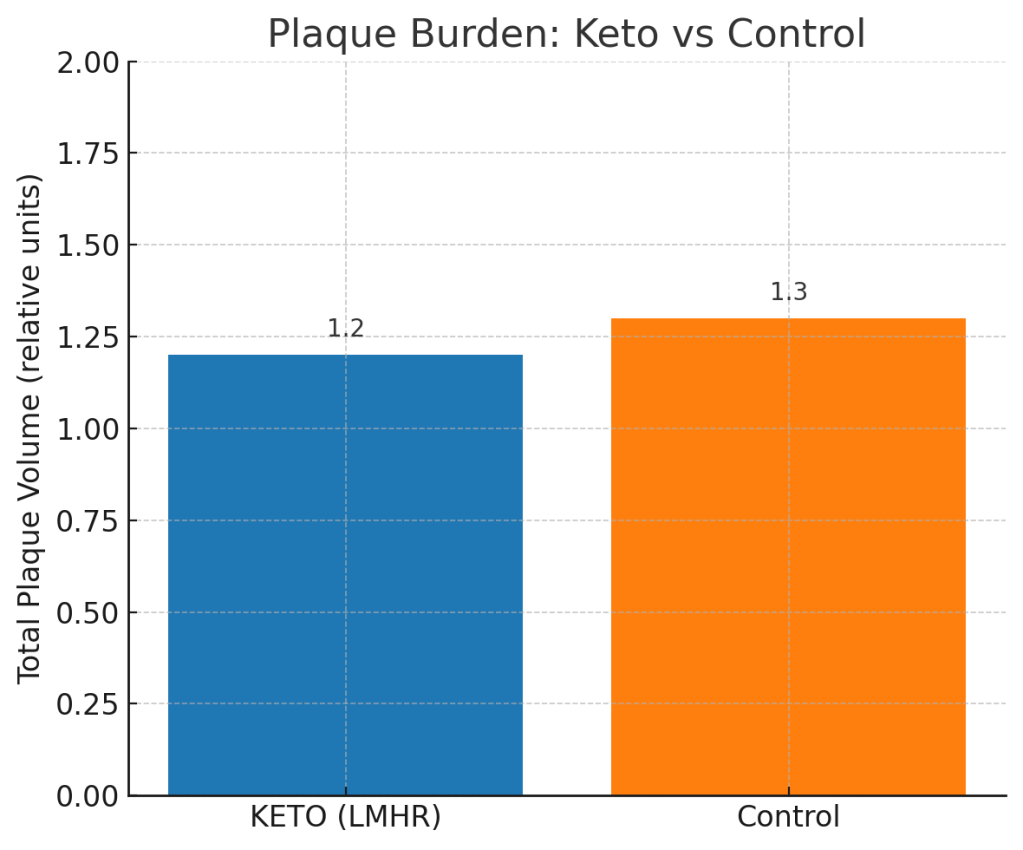
    Plaque Burden: Keto vs Control


    It shows that total arterial plaque volume was almost identical between the Keto (LMHR) group and the control group – matching the study’s conclusion that extremely high LDL did not translate into greater plaque.

    🧪 How Was the KETO-CTA Study Done?

    This was an observational, non-randomized, matched cohort study — meaning participants were not randomly assigned to diet groups.
    Researchers compared 80 people who had followed a ketogenic diet for an average of 4.7 years (all with LDL ≥ 190 mg/dL, average ~272 mg/dL, some up to 591 mg/dL) with 80 matched controls from the MiHeart study who had typical LDL levels (~123 mg/dL).

    Both groups were similar in age, sex, BMI, blood pressure, and smoking history.
    Advanced imaging — coronary CT angiography (CCTA) and coronary artery calcium (CAC) scoring — was used to measure arterial plaque and calcium buildup in the heart.

    Because this was not a randomized controlled trial, the results do not prove cause and effect, but they do provide strong observational evidence that, in this specific population, high LDL on a ketogenic diet did not correspond to more arterial plaque.


    📚 Reference

    Budoff, M. J., Soto-Mota, A., Norwitz, N. G., Feldman, D., et al. (2024). Carbohydrate restriction–induced elevations in LDL cholesterol and atherosclerosis in lean mass hyper-responders: The Keto-CTA study. JACC: Advances. https://doi.org/10.1016/j.jacadv.2024.101109

  • 🧬 Does High Cholesterol Always Mean Risk? Discover the Surprising LMHR Phenotype

    In recent years, the conversation around health and nutrition has increasingly shifted toward personalized care. One of the most intriguing topics in this space is the concept of the Lean Mass Hyper-Responder (LMHR) phenotype, identified by American researcher and engineer Dave Feldman.

    🔍 What Is LMHR?

    LMHR stands for Lean Mass Hyper-Responder. It describes individuals who, after adopting a low-carbohydrate or ketogenic diet, experience a sharp rise in LDL cholesterol levels, while maintaining excellent health markers in every other area.

    A typical LMHR lipid profile looks like this:

    • LDL-C (“bad cholesterol”): over 200 mg/dL (5.2 mmol/L),
    • HDL-C (“good cholesterol”): over 80 mg/dL (2.1 mmol/L),
    • Triglycerides: very low, usually below 70 mg/dL (0.8 mmol/L).

    Sounds like a paradox, right? Traditional medical advice warns us about high LDL-C, yet these individuals are lean, physically active, metabolically healthy, and show no signs of inflammation or insulin resistance.

    👨‍🔬 Who Is Studying This?

    Dave Feldman began researching this phenomenon after observing a dramatic spike in his own LDL-C levels when he switched to a ketogenic diet, despite his other health markers being ideal. He launched the Citizen Science Foundation and, in collaboration with UCLA, started the Lean Mass Hyper-Responder Study in 2022.

    The aim of the study is to determine whether individuals with the LMHR phenotype are genuinely at cardiovascular risk or if their elevated LDL-C is simply a natural adaptation to using fat as their primary fuel source.

    📊 What Do Early Findings Show?

    Initial data—including advanced coronary imaging (CCTA)—reveals that many LMHR participants show no signs of arterial plaque, even with extremely high LDL-C levels.

    One published case report describes a healthy 26-year-old male who switched to a ketogenic diet and saw his LDL-C soar to 545 mg/dL. Despite this, a CT scan revealed clear arteries and no signs of atherosclerosis.

    Source: PMC9048595

    ❗ Does That Mean LDL Doesn’t Matter?

    Not necessarily. Feldman is very clear: this does not give everyone permission to ignore high LDL-C. The LMHR pattern appears in a specific group of individuals—those who are lean, insulin-sensitive, and have a favourable lipid profile otherwise.

    For people who are overweight, sedentary, or have metabolic issues, high LDL-C can still be a significant risk factor.

    👣 What Does This Have to Do with Foot Health?

    As a Foot Health Practitioner, I work with many clients dealing with diabetes, obesity, and metabolic syndrome. These conditions not only affect cardiovascular health but also directly impact the circulatory health of the feet—increasing the risk of ulcers, infections, and poor healing.

    Understanding phenotypes like LMHR helps us avoid one-size-fits-all thinking. Not all high LDL-C readings mean the same thing. For some, a low-carb lifestyle improves insulin levels, reduces inflammation, and ultimately supports better foot and overall health.


    📚 Sources:

  • Low-Carb and Keto Diets: Effects on Blood Vessels and Cardiovascular Health

    Low-carbohydrate (low-carb) and ketogenic (keto) diets have gained popularity as effective approaches for weight management, blood sugar control, and metabolic health. However, their impact on the cardiovascular system, particularly on blood vessels, remains a subject of scientific debate. This article explores the effects of these diets on vascular health, including their influence on cholesterol levels, arterial function, and overall cardiovascular risk.


    1. Understanding Low-Carb and Keto Diets

    A low-carb diet typically restricts carbohydrate intake to 50–150 g per day, while a ketogenic diet is even more restrictive, limiting carbohydrates to below 50 g per day and increasing fat intake to induce ketosis, a metabolic state where the body primarily burns fat for energy. These dietary patterns focus on consuming healthy fats, proteins, and non-starchy vegetables, while minimizing sugars and processed carbohydrates.


    2. How Low-Carb and Keto Diets Affect Blood Vessels

    2.1. Effects on Cholesterol and Lipid Profiles

    One of the main concerns regarding low-carb and keto diets is their effect on cholesterol levels, which are closely linked to cardiovascular health. Studies suggest:

    • LDL Cholesterol (“Bad” Cholesterol)
      • Some individuals experience an increase in LDL cholesterol when following a high-fat keto diet. However, emerging evidence suggests that LDL particle size and density may be more important than total LDL levels. Small, dense LDL particles are more atherogenic (plaque-forming), whereas large, fluffy LDL particles are less harmful.
      • A meta-analysis of randomized controlled trials found that while LDL levels may rise in some cases, the LDL/HDL ratio and triglyceride levels tend to improve with low-carb diets.
    • HDL Cholesterol (“Good” Cholesterol)
      • Keto and low-carb diets are known to increase HDL levels, which helps remove cholesterol from arteries and reduces cardiovascular risk.
    • Triglycerides
      • Triglycerides, a type of fat linked to heart disease, decrease significantly on low-carb diets, reducing the risk of atherosclerosis.

    2.2. Effects on Arterial Function and Endothelial Health

    The endothelium, the inner lining of blood vessels, plays a crucial role in vascular tone, blood pressure regulation, and preventing atherosclerosis.

    • Reduced Inflammation
      • Low-carb and keto diets are associated with a reduction in inflammatory markers, such as C-reactive protein (CRP) and interleukin-6 (IL-6), which are linked to arterial damage and cardiovascular diseases.
      • Lower insulin levels and blood sugar fluctuations on keto diets help protect endothelial function.
    • Blood Pressure Regulation
      • Several studies indicate that low-carb diets lead to lower blood pressure, reducing strain on blood vessels.
      • A systematic review and meta-analysis found that low-carb diets significantly reduce systolic and diastolic blood pressure compared to high-carb diets.
    • Atherosclerosis and Plaque Formation
      • Some concerns exist regarding potential arterial stiffness due to saturated fat intake in keto diets. However, recent studies suggest that a well-formulated low-carb or keto diet, emphasizing unsaturated fats (e.g., olive oil, avocados, nuts), does not increase arterial stiffness and may even reduce plaque buildup in some individuals.

    3. Keto Diet, Type 2 Diabetes, and Vascular Complications

    People with diabetes and metabolic syndrome are at higher risk for vascular complications, including peripheral artery disease, retinopathy, and nephropathy. The keto diet has shown promise in improving vascular function in these individuals:

    • Improved Insulin Sensitivity
      • Chronic high blood sugar damages blood vessels. Low-carb and keto diets reduce insulin resistance and lower fasting glucose levels, helping to prevent vascular damage.
    • Reduction in Advanced Glycation End Products (AGEs)
      • AGEs contribute to vascular stiffness and atherosclerosis. Keto diets, by reducing blood sugar spikes, lower the formation of AGEs, protecting blood vessels.

    4. Addressing Concerns: Are Low-Carb and Keto Diets Safe for the Heart?

    While some studies raise concerns about long-term effects, well-balanced low-carb and keto diets that prioritize healthy fats (monounsaturated and polyunsaturated), high-quality proteins, and fiber-rich vegetables can be beneficial for cardiovascular health.

    Who Should Be Cautious?

    • Individuals with pre-existing heart disease: Regular lipid monitoring is recommended.
    • Hyper-responders to dietary cholesterol: Some people experience a significant rise in LDL cholesterol, requiring adjustments (e.g., replacing saturated fats with unsaturated fats).
    • People with familial hypercholesterolemia: Genetic predisposition to high cholesterol may require dietary modifications.

    5. Conclusion: A Personalized Approach to Cardiovascular Health

    Low-carb and keto diets can positively impact blood vessels by reducing inflammation, improving lipid profiles, and lowering blood pressure. However, dietary quality matters—prioritizing healthy fats, fiber, and nutrient-rich foods is essential for maintaining cardiovascular health.

    For individuals considering these diets, regular check-ups, lipid monitoring, and a well-balanced approach tailored to individual health conditions are key to optimizing vascular health and minimizing risks.